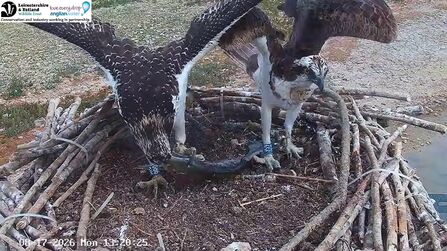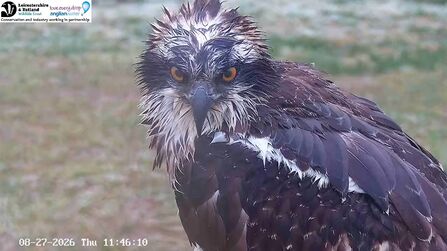

As all three got more confident in their flying abilities, 8R7(26) caused a bit of concern on 22nd July. Seen leaving the nest just after 6am, he was absent for a large portion of the day, but returned to the nest just after 4pm, having not been seen at any of his usual spots during that time at all.
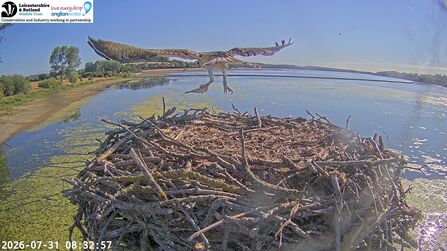
It was then 8R5(26)’s turn to disappear, spending extended periods off the nest and then, on 31st July, we saw him for the final time this year, flying off the poplar branch after a large breakfast, off round the back of the poplar trees and away. At the time, he was 80 days old, so rather young for migration, but he had proven to be a strong chick during his 29 days since fledging. Hopefully, we’ll see him again in two years.
Seemingly inspired by her male siblings, 8R6(26) then had a period of disappearing from the nest for more than a day at a time but, after a week of this, then stayed around the nest. However, on the morning of Friday 21st August, both 8R6(26) (99 days old) and 8R7(26) (96 days) were seen spiralling up on thermals over Manton Bay, led by 33(11), a short while after 10:15am. Neither of the chicks were then seen on or near the nest, so had obviously started to make their way south. It's interesting that they chose to go together. The winds were favourable that day, blowing from the north west, so we hope they both made swift, and safe, progress.
Meanwhile, over on our previously unoccupied nest this season, at Lagoon 4 on the reserve at Egleton, we suddenly had a regular visitor. We were able to see this close up thanks to the two cameras now installed at the nest. Identified as 9R0(26), one of the chicks from Site B, she was being visited by her male parent, 359(21), who would bring fish and sticks. This went on for a few weeks.
The sharp-eyed of you might remember the number 359(21) as he was one of the pair that spent a lot of time at Lagoon 4 last year, but he and 3H9(23) went their separate ways when they returned this year, taking up spaces on nests where experienced parents didn’t return. 359(21) took over from 30(10) at Site B, pairing with HJ8(14), and they had two chicks – 8R9(26) and 9R0(26). According to Tim Mackrill, HJ8(14) looked like she had already migrated and 359(21) was left feeding the two chicks, with 8R9(26) staying at Site B and 9R0(26) moving to Lagoon 4. Interesting behaviour and possibly shedding some light on the off-nest time of our Manton Bay chicks. Last year, 3R7(25) had a couple of extended periods away from the nest, so perhaps 33(11) has also developed a technique of separating the chicks as part of their training, or maybe even to alleviate any potential conflict between growing siblings.
In terms of the other nests in the surrounding area that Tim Mackrill monitors, he has confirmed that we have had an amazing total of 24 chicks this year across 12 nests. Also, in addition to the unfertilised egg on the Manton Bay nest, Tim told us that there were a few other nests where unhatched eggs were discovered during the ringing visits. This could have partly been down to either the weather conditions or some inexperienced parenting, or a bit of both.
With all three Manton Bay chicks having migrated by the 21st August, that just left Maya and 33(11) at Manton Bay, weathering the atrociously wet conditions at the end of August, which made for such a contrast to the prolonged hot and dry summer that they had experienced to that point. Maya was last seen flying away from Manton Bay at 10:15 on 1st September and 33 stayed for two more days, spiralling up and heading off in a southerly direction just after midday on the 3rd.
Over on Lagoon 4, 9R0(26) stayed until 5th September, but 359(21) was around for several more days before migrating and was last seen on the perch behind the nest on 20th September, making him probably the last Osprey to leave the area this year.
So that's another exciting and successful season in the books, although we never did get any sightings of the return of 1R0(24), the solitary Manton Bay chick from 2024. But perhaps we might see him next season and we might get to see or hear of our 2025 youngsters, 3R5(25), 3R7(25) and 3R8(25). Keep your eyes to the skies from March 2027 onwards and we'll find out!